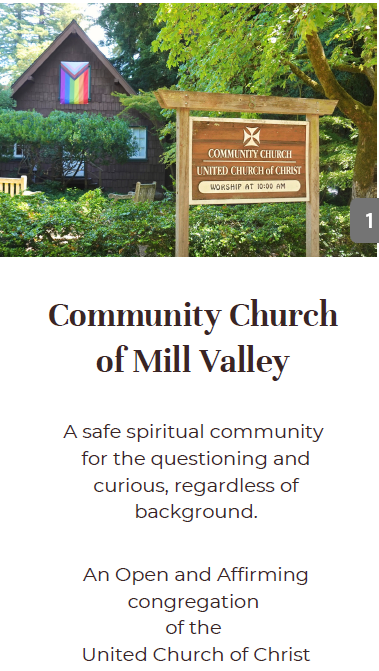
Community Church of Mill Valley has a history of 100 years of service to the community and the larger world.
Play:
The founding of the Community Church of Mill Valley, 1924
Our History
-
THE HISTORY OF THE COMMUNITY CHURCH OF MILL VALLEY
HOW IT ALL STARTEDOct 9, 1924 advertisement in the Mill Valley Record
Why did they think that they needed a new kind of church?
The decade after the end of World War I brought a lot of change to Mill Valley.
The small mountain town had, until then, been mostly a summer resort for San Franciscans but now it became a real city with full time residents and a booming real estate market. New people arrived to make Mill Valley their home, but an odd thing happened. The way new people became part of a community had long been by joining a local church; however, in the 1920s, while many new residents acknowledged the usefulness of a church to the community, traditional churches did not appeal to them. At the same time, many members within the local Congregational Church felt their church had to change. Carol Donnan Fowler later wrote,
“A group began to form among the members of the Congregational Church, who envisioned a different kind of church, one that belonged to no denomination, had no rigid structure, that welcomed all who believed in God and in Jesus Christ. In the post-war period there was optimism and courage, a readiness for innovation and social change.”
The church members were clearly influenced by modern “ecumenism,” a movement that was gaining much support in the post war years. It desired to unite Protestants by setting aside denominational divisions. Community churches were originally created in rural areas where, to have a church at all, people from several denominations would worship together. The interest in this kind of independent church was rising fast after the war, and where people would once have worshiped together out of necessity, they would now come together by choice. The local newspapers brought inspiring stories of such community churches, some in the Bay Area, and the question came up for many: should and could a community church be created in Mill Valley?
In the summer of 1924, the Congregational Church reached out to residents in Mill Valley and the surrounding area, particularly the ones who had been avoiding churches. Within a month the invitation to join the effort had been spread by word of mouth or phone to around 40 families. Committees were created to attract and educate the whole community through public meetings, often with visiting speakers and music. Behind it all, a group started to create the framework for a new church.
Riding on a wave of community enthusiasm, the Federated Community Church of Mill Valley was established on February 5, 1925.
What was their vision for the new church?
The founders considered the prescribed creeds of denominations artificial and nonessential to the Christian faith. The traditions associated with them unnecessarily kept people apart instead of bringing them together. The Community Church supported the right of each person to find their own understanding of the Christian faith while also respecting the views of others.
It would be a “modern” and curious church, open to science and new ideas (like evolution).
Following the core ethical principles of Christianity, they intended the Community Church to be a great force of good for the city of Mill Valley.
Their vision is well phrased in Rev. Art Casaday’s statement from 1941.
The Purpose of the Church
This church was founded in 1925 and is sustained today for the purpose of providing a fellowship and a place of meeting where all Christians, regardless of creed, can work and worship together.
Differences of opinion and belief are expected, but a common loyalty to Jesus Christ and a common aspiration to live in this world as good members of God’s Universal Family bind the membership together in mutual respect and affection.
Through its worship, its education, its recreation, and its social service, the Church is seeking to help persons of all ages grow up to full and mature manhood and womanhood as children of God - aware of and responsive to the Spirit of God “in whom we live and move and have our being.”
More details about the prehistory of CCMV:
The quote about the Congregational Church comes from Carol Donnan Fowler. She was a young woman in the Congregational Church at the time.
-
In October of 1924 the founders of CCMV gave themselves four months to attract members and volunteers. They invited the public to a speaker series with well known ministers as well as excellent music, all taking place at the attractive and conveniently located Outdoor Art Club. Attendance was high and “Community Church” was the talk of the town. By December the speaker series became weekly church services with various Bay Area ministers, a full choir, Sunday school and several youth programs. The Federated Community Church was officially founded in February of 1925 and its rental arrangement with OAC became ongoing. Services were held every Sunday evening with a 6-8 week summer break and additional space would be rented for the Sunday School and several youth groups.
Now they just needed a permanent minister. They were lucky.“The joining of a liberal, ecumenical educator
with an upstart group like our founders seems to have been a
miracle or a stroke of genius.”
Carol Donnan Fowler, long-time CCMV memberDr. Lynn T. White had been received with much enthusiasm at one of the speaker evenings. Asked to be their minister he agreed and together they created a Community Church service that with its tolerance of differences, love of music and scholarly sermons would feel familiar to us today. Most of the founders were college educated, men as well as women, and they enjoyed the intellectual challenge. Dr. White was also a man of compassion and kindness and they would later remember him with much affection.
The working framework for the church was adapted from the tradition of its co-founder, the Congregational Church of Mill Valley. Local autonomy, democratic decision-making and an elected board of trustees seemed a good fit, but every new organisation will encounter a learning curve, no matter how dedicated its volunteer board members are. Triple C (the Community Church Club), the only church social group for adults, was intended to be a women's auxiliary, but as the new Community Church was formed, it became much more. Since Dr. White was already a full time seminary teacher, he asked Triple C to take over his pastoral duties and to be the friendly inviting face of the church to the community of Mill Valley. Triple C was also a sounding board for the trustees, providing feedback from the congregation, and since their cooperation might be needed, Triple C representatives were frequently invited to board meetings. At the end of 1920s the church organization was running much more smoothly, but Triple C remained an important part of the church for the next 75 years.
From early on, members asked: can’t we build a church now? The board had financial reasons to say no, but by 1928 they were out looking at lots and they were considering perhaps duplicating the Outdoor Art Club building. In August of 1929, needing more space for the youth programs and feeling pressured by the rising cost of the rent at OAC, the board decided to seriously investigate its options. Should they look elsewhere for cheaper rent and more space or should they finally move ahead and build a church?
The Wall Street crash in October of 1929, could have stopped anyone’s building plans, but by November it was clear that the board favored building.
They also knew where to build it.Before co-founding the Community Church, the Congregational Church had bought two lots at the corner of Throckmorton and Olive, intending to build a new church on them. Now divesting of their properties, in 1926 they had offered the lots to the Community Church, but at the time the church could not afford them. By 1929, the lots still available, it seemed fitting that the Community Church now would be the one to build a church at the site.
-
Coming Soon…
Printable History Brochures
(click image to preview the brochure)